




















Artificial Intelligence Capability Census 2026
Providing the latest evidence-based picture of AI adoption, capability, employment, investment and economic impact across Northern Ireland.

Providing the latest evidence-based picture of AI adoption, capability, employment, investment and economic impact across Northern Ireland.
The Artificial Intelligence Collaboration Centre (AICC) has published the 2026 AI Capability Census, revealing a year of significant growth across Northern Ireland’s AI economy.
Northern Ireland’s artificial intelligence ecosystem has doubled in size in just twelve months, with the new Census identifying 400 firms actively engaged in AI development or deployment, compared with 198 in the inaugural 2025 study.
Commissioned by the AICC and independently prepared by Perspective Economics, the research also shows strong growth in AI-related employment and economic contribution. Estimated employment has increased by 79% to 2,402 full-time equivalent roles, while estimated AI-related Gross Value Added (GVA) has risen from £82 million to £214 million.
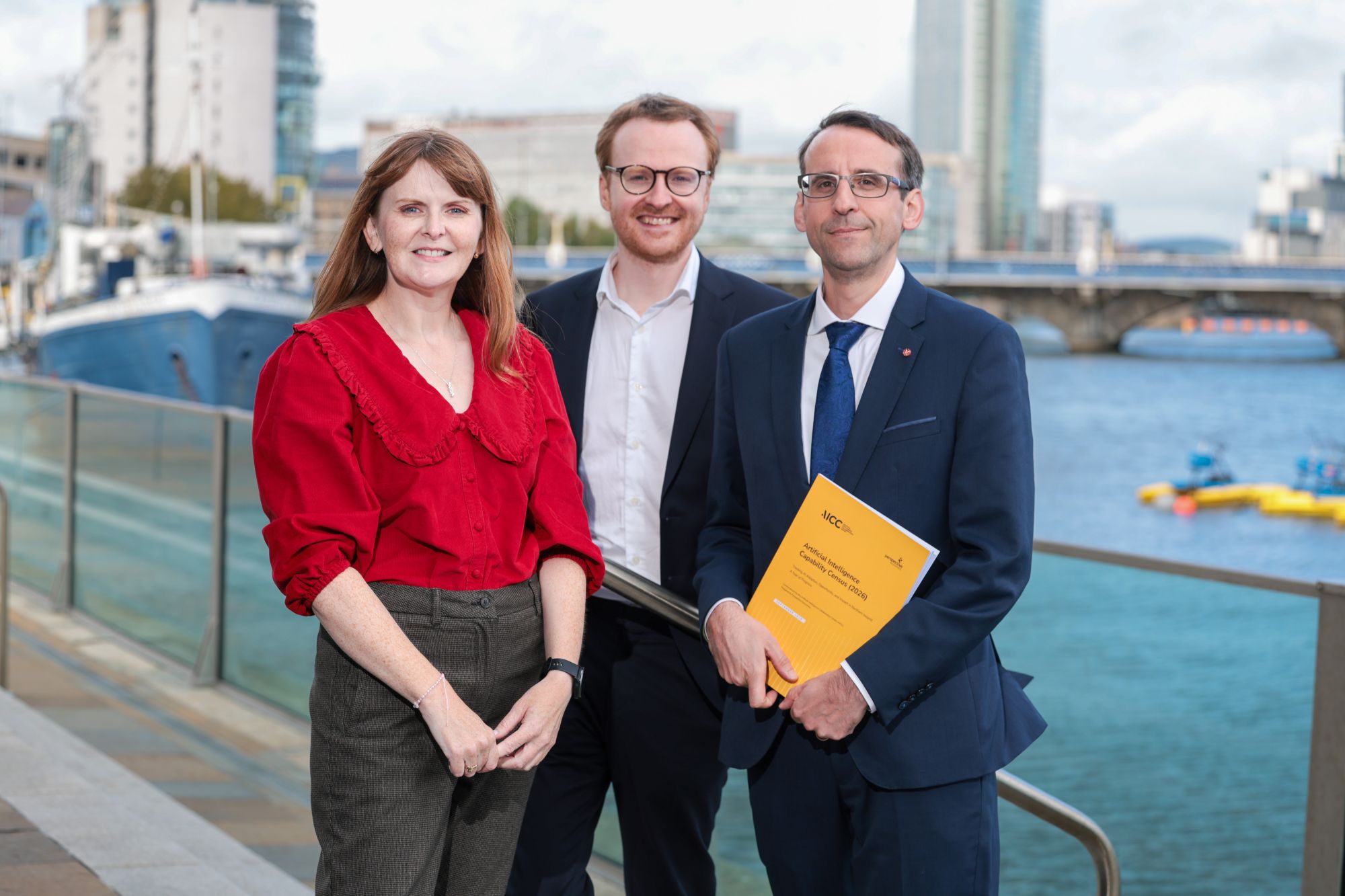

The findings mean Northern Ireland has already surpassed the moderate growth scenario set out in last year’s Census, which projected more than 2,000 AI professionals and £200 million in AI-related GVA by 2028, reaching that milestone two years ahead of schedule.
Economy Minister Dr Caoimhe Archibald MLA said:
“These findings demonstrate the growing momentum across the AI economy in the north. To see the number of businesses commercially engaged with AI double in only twelve months, alongside strong growth in employment and economic contribution, is very encouraging.
“Artificial intelligence has the potential to support our ambitions for a more productive, innovative and regionally balanced economy. My focus remains on ensuring businesses and our workforce have the skills, confidence and support to adopt these technologies responsibly, ethically and effectively.
“The evidence provided by the AI Capability Census will help us understand both the opportunities and challenges in more depth as we work collaboratively to further strengthen the north’s position in this rapidly developing area of technology, including through my AI Advisory Panel.”

The Census suggests that Northern Ireland’s AI ecosystem is moving beyond an early-stage market, with growth coming from new AI companies, inward investment and established businesses increasingly embedding AI into their products and services.
However, the research also highlights the next challenge of converting rapid growth in AI capability into wider adoption across the economy. Around 45% of Northern Ireland businesses still report that they are not currently using AI, while access to investment and the ability of smaller firms to scale remain areas requiring continued focus.
David Crozier CBE, Director of the Artificial Intelligence Collaboration Centre, said:
“Northern Ireland is no longer an emerging AI economy. It is one where AI adoption, diffusion and economic impact is accelerating at pace across every postcode.
“The significance of these findings is not simply that Northern Ireland has more AI companies or more AI-related jobs. It is that AI is becoming a more meaningful part of our economy, with businesses increasingly building capability, creating value and applying the technology in real-world settings.
“Our focus now has to be on turning that momentum into long-term advantage, helping more businesses adopt AI effectively, supporting promising companies to grow, and ensuring Northern Ireland has the skills and capability to compete in a rapidly changing global economy.”

Demand for AI skills is also rising sharply. Northern Ireland job advertisements requesting an AI or machine learning skill increased by 161% on a rolling twelve-month basis, while median advertised salaries for AI roles stood at approximately £61,000 in the first half of 2026.
Firms included in the Census have also raised approximately £158 million in equity investment since 2024, although Northern Ireland still accounted for less than 1% of UK AI equity investment by value in 2025.
Sam Donaldson, Director of Perspective Economics and author of the Census, said:
“One of the most interesting findings is the breadth of the growth. It is not being driven by one type of company or one part of the market.
“We are seeing new dedicated AI firms emerging, established technology and professional services businesses expanding their AI teams, and companies in more traditional sectors adding AI to existing products and services.
“That points to an ecosystem that is becoming broader and more embedded across the economy. At the same time, the data shows clear gaps around investment, wider business adoption and the progression of smaller firms into larger scale businesses, which will be important areas to watch over the next year.”
Looking ahead, the Census points to a need to support businesses to move from initial AI use towards deeper integration, strengthen AI skills, help promising firms scale and build long-term capability across the ecosystem.
To discuss this report please get in touch with us at aicc@ulster.ac.uk or contact the Perspective Economics Research Team at info@perspectiveeconomics.com.

Innovation thrives through connection. Whether you're an SME, researcher, or professional exploring AI, we’re here to help.